
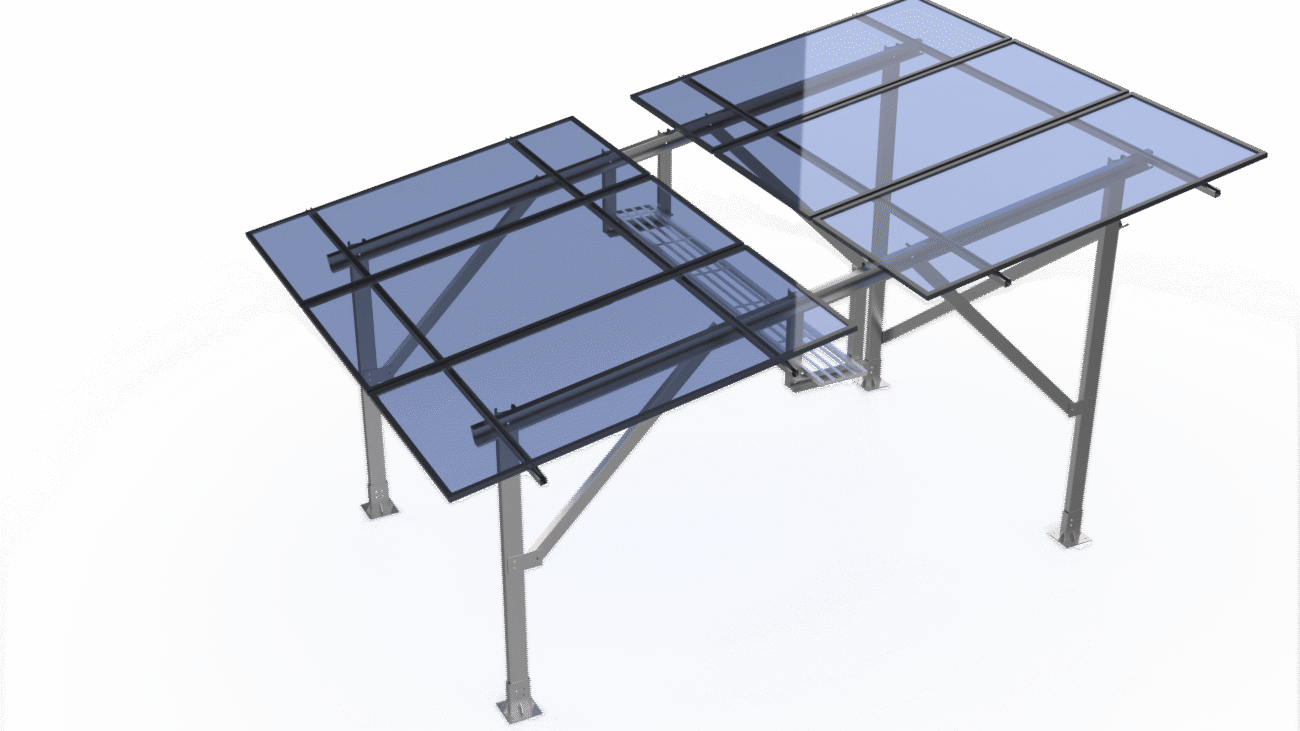
When people evaluate a rooftop solar system, most of the attention goes to panels and inverters. The structure is often treated as a secondary component — something that simply holds everything in place.
But in reality, the structure is what carries the entire system for 20–25 years.
If the structure is not designed correctly, the risks are not immediate — they show up over time. Misalignment, stress buildup, deformation, and in worst cases, structural failure. By the time these issues become visible, the damage is already done.
This is where the difference between engineering-led design and cost-driven fabrication becomes critical.
1. Designed Scientifically, Not Approximate Solutions
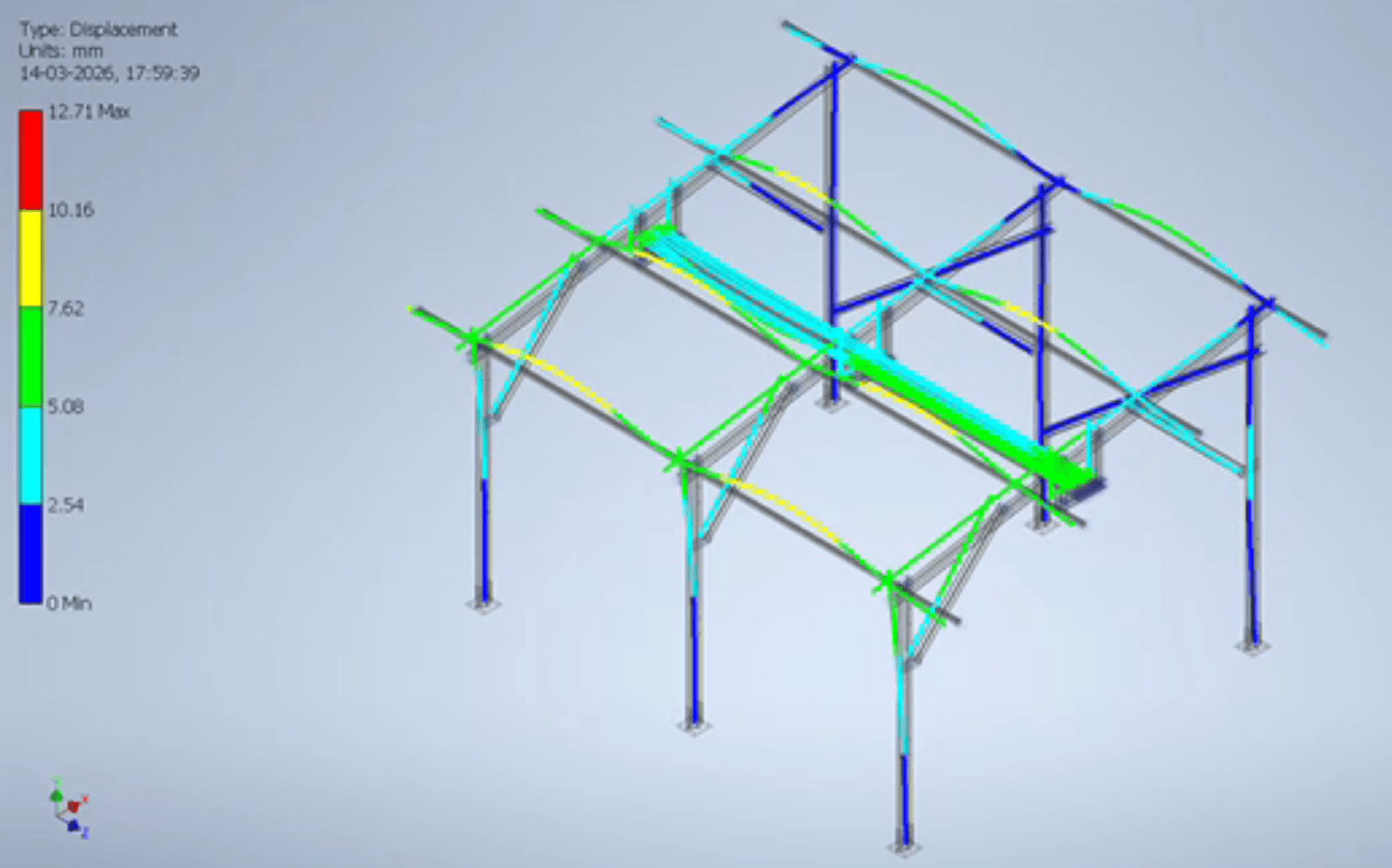
At Structura, every structure begins with engineering, not approximation.
We use:
- Structural analysis tools like FEA (Finite Element Analysis)
- Load simulations based on wind, weight, and real-world conditions
This helps us determine:
- How forces move through the structure
- Where stress concentrations can occur
- What size and thickness each member actually requires
In contrast, many market solutions are still based on rough calculations or past templates. This typically leads to two extremes:
- Structures that are too light and prone to long-term failure
- Structures that are unnecessarily heavy and expensive
A well-engineered structure sits in between — optimized for both strength and efficiency.
2. Column Base: The Most Underrated but Critical Component
The column base is not just a support plate. It is the foundation of load transfer between the structure and the rooftop.
In structural engineering, base plates are sized based on:
- Load magnitude
- Bearing pressure on the foundation
- Long-term stress distribution
Heavier base plates are used in critical structures because they:
- Distribute loads more evenly
- Reduce stress concentration at connection points
- Improve long-term stability under cyclic loads (like wind)
At Structura:
- We use a heavy column base with four bolted connections
- Two bolts include capsule slots, allowing minor adjustments during installation
This design helps:
- Maintain proper alignment
- Reduce shear stress in columns caused by uneven surfaces or installation deviations
- Prevent long-term fatigue in structural members
When this detail is overlooked, even small misalignments can introduce stress into the columns — and over time, that stress compounds.
3. Bracing Connection: Where Real Engineering Shows
Bracing is meant to stabilize the structure. But it only works when connected correctly.
We use:
- Dedicated bracing plates placed at the vertical center of the column
- Double-bolted connections to secure the plate
Why vertical center matters:
- It aligns the force path with the column axis
- Reduces torque on the column
- Converts lateral forces into vertical loads, which columns are designed to handle more efficiently
Why double-bolted connections:
- Prevent rotation or loosening over time
- Provide redundancy and stability
In many market implementations, bracing is connected using:
- Offset joints
- Single bolt connections
- Improvised attachments
These methods may look acceptable initially, but:
- They introduce torque into the column
- Reduce the effectiveness of bracing
- Can make the entire bracing system functionally weak
In such cases, the structure behaves closer to an unbraced system, increasing long-term risk.
4. Strengthening Critical Joints: Column to Rafter
The column-to-rafter joint is one of the most critical load-bearing connections in the entire structure.
At Structura:
- We use a double-bolted connection
This improves:
- Load sharing between fasteners
- Joint stiffness
- Alignment of structural members
This approach is not new — it is already a standard practice in ground-mounted systems, where structural loads are even more demanding.
However, in rooftop structures, this is often simplified to reduce cost, which directly impacts the integrity of the frame.
5. Walkway System: Integrated, Not Added Later
Walkways are often treated as an afterthought. But in reality, they introduce additional loads and interaction with the structure.
Our walkway system is:
- Connected directly to rafters using double-bolted joints
- Designed using structural analysis, not assumption
- Built using welded pipe platforms
This allows:
- Safe load handling up to approximately 300 kg
- Minimal impact on primary structural members
In contrast, common issues seen in the market:
- Walkways connected to columns instead of rafters
- Load transfer into unintended members
- Visible deflection or bending under use
These are not just visual issues — they indicate structural inefficiency and long-term risk.
6. Fasteners: Small Component, Big Impact
Structural integrity depends heavily on connections.
We use:
- SS304 grade bolts
- 12 mm diameter for structural joints
This ensures:
- Corrosion resistance over time
- Consistent clamping force
- Reliable joint performance
Using undersized or lower-grade fasteners may reduce upfront cost, but it weakens the system where it matters most — at the connections.
7. Material Selection: Right-Sized, Not Cost-Driven
All structural members are selected based on analysis, not assumption.
We use:
- Roll-formed sections with minimum 2 mm thickness
- Profiles sized as per actual load requirements
The goal is simple:
- Avoid under-designing for cost
- Avoid over-designing for safety margins without reason
This balance ensures:
- Structural reliability
- Cost efficiency
- Predictable performance over time
8. Designed for Real Conditions, Not Standard Templates
No two rooftops are the same.
Factors like:
- Wind zones
- Roof conditions
- Tilt requirements
- Layout constraints
All influence structural design.
At Structura:
- We have an in-house design team
- Structures are customized and modular
- Designs are adapted based on project-specific requirements
This allows:
- Better system efficiency
- Improved installation feasibility
- Long-term structural reliability
Standard, one-size-fits-all solutions often ignore these variables — and that’s where problems begin.
Conclusion
A rooftop solar structure may look simple, but its performance depends on a series of engineering decisions.
Each connection, each member, and each detail contributes to how the system behaves over time.
The difference is not always visible on day one.
But over years, it becomes the difference between:
- Stability and deformation
- Reliability and failure
- Confidence and risk
At Structura, the focus is clear:
Every structure is designed with intent, validated through analysis, and built for long-term performance.
Because in solar, it’s not just about installing a system —
it’s about ensuring it performs reliably for decades.